Short answer: Choose a roll-off for a project with a start and an end: a remodel, a roof, a cleanout, a build. Choose front-load service for ongoing trash at a business or apartment building, emptied weekly or more often. Many businesses use both: front-load for daily waste and a roll-off for occasional projects.
Two containers, two jobs
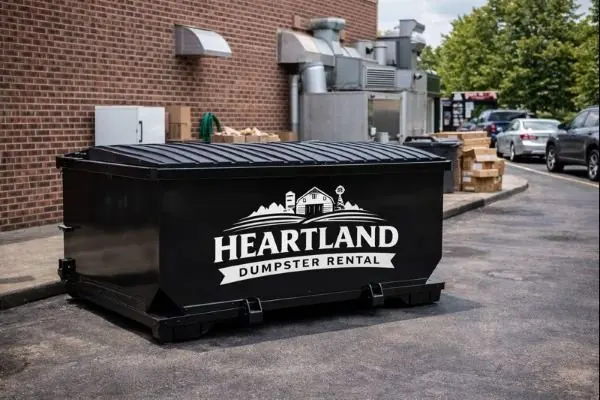
Walk behind almost any Midwest strip center and you will see both kinds of dumpster. The squat, lidded bins next to the back door are front-load containers: the restaurant's or the store's everyday trash, emptied on a schedule. The long open-top box in the parking lot with drywall sticking out is a roll-off: someone is remodeling a unit. They do different jobs, they are priced differently and they are serviced by different trucks.
How a roll-off works
A roll-off is a long, open-top steel container, usually 10 to 40 cubic yards. A roll-off truck tilts its bed and slides the container onto the ground on steel rails. When it is full, the truck winches it back up and takes the whole thing to a transfer station or landfill, where it is emptied and then delivered to the next customer.
Roll-offs are rented by the job. You pay for a rental period, a weight allowance and the haul. They suit anything with a beginning and an end: remodels, roofs, cleanouts, construction, demolition and storm cleanup. See roll-off dumpsters for sizes.
How front-load service works
A front-load bin is a smaller container, usually 2 to 8 cubic yards, with a lid and pockets on the sides. A front-load truck drives up, slides its forks into the pockets, lifts the bin over the cab and tips it into the truck's body. The bin stays where it is. The truck moves on to the next stop on its route.
Front-load service is sold as an ongoing contract: a bin size and a pickup frequency, once a week, three times a week, daily. It suits businesses and multi-unit properties that generate trash steadily: restaurants, retail stores, offices, apartment complexes, schools.
Side-by-side
| Roll-off | Front-load | |
|---|---|---|
| Typical size | 10 to 40 cubic yards | 2 to 8 cubic yards |
| Top | Open, sometimes tarped | Hinged lids |
| Service model | Rented per project | Ongoing contract |
| How it is emptied | Whole container hauled away | Lifted and tipped into the truck on site |
| Best for | Remodels, roofs, cleanouts, construction | Daily or weekly business trash |
| Space needed | Long straight approach, room for a 20-plus-foot box | A small pad or enclosure |
| Typical debris | Bulky building debris, junk, shingles | Bagged trash, food waste, cardboard |
Which one does your situation need?
You are a homeowner with a project. A roll-off. Front-load service is not built for one-time residential jobs.
You are a contractor. A roll-off on each job site, swapped as needed. Our construction dumpster rental page covers swaps and phases.
You run a restaurant, store or office. Front-load service for daily waste. Add a roll-off when you renovate, reset fixtures or clear out storage.
You manage apartments. Front-load (or compactor) service for residents' everyday trash. Roll-offs for unit turnovers, move-out weeks and renovations, placed where residents will not fill them with household junk.
You run a warehouse or plant. Often both. Front-load or larger permanent containers for steady waste; roll-offs for purges, retooling and construction.
Cost differences
Roll-offs are priced per rental. Fixr cost data (2025, checked October 2026) puts typical US weekly roll-off rentals at $200 to $550, with larger containers higher; see the pricing page. Front-load service is priced per month based on bin size and pickup frequency, and contracts often run a year or more. Comparing them directly is not useful; they solve different problems.
Common mistakes
- Using a front-load bin for a remodel. The bin fills in an hour and the hauler may refuse construction debris in a trash bin. Rent a roll-off.
- Keeping a roll-off as a permanent trash container. It is open-topped, so rain gets in, and it is priced for projects. For ongoing waste, use scheduled service.
- Ignoring placement. A roll-off needs a long straight approach and overhead clearance. A front-load bin needs a pad the truck can reach head-on. Plan the spot before you book.
- Forgetting lids and local rules. Many cities require lids on commercial refuse containers to control pests and odors, and alley placement may need a permit.
Midwest considerations
Winter matters for both. Snowplows push snow against bins and block roll-off access; keep the approach clear. Freeze-thaw damages pavement under heavy containers, so concrete pads are worth it for permanent bins. In cities with alleys, such as Chicago, St. Louis and Milwaukee, both kinds often live in the alley, and the city may regulate placement.
Getting a roll-off lined up
Call (816) 895-7039 with the address, the project and the dates. We line up an independent local hauler with the right roll-off. If you also need ongoing service, mention it; commercial dumpster rental covers business projects in more depth.
Other container types you may hear about
Rear-load bins are similar to front-load bins but are lifted from the back of the truck; they are common where space is tight. Compactors are permanent machines that crush trash into a sealed container, used by large retailers and apartment complexes. Dumpster bags are heavy-duty fabric bags for very small jobs, picked up by a truck with a crane. For most Midwest homeowners and contractors with a project, though, a roll-off is the right tool.
If you are still unsure which type fits, describe the waste and how often it is produced when you call, and we will point you the right way.
Keep reading
- What size dumpster do I need?Match 10, 20, 30 and 40 yard dumpsters to cleanouts, remodels, roofs and construction, and learn why weight, not volume, usually decides. Call for help.
- What can't go in a dumpsterItems haulers and landfills commonly refuse in a rental dumpster, from tires and batteries to paint and refrigerant appliances, and where to take them instead.
- How long can you rent a dumpster?How dumpster rental periods work, what extra days typically cost, when a monthly rate makes sense and how to time a rental around weather and permits.
- Construction waste disposal guideHow to plan construction and demolition waste on a Midwest job site: container sizes by phase, sorting, recycling, hazardous materials and OSHA housekeeping.
Questions callers ask us
Can a homeowner rent a front-load dumpster?
Usually not for a one-time project. Front-load service is built around ongoing contracts for businesses and multi-unit properties. For a home project, a roll-off is the normal choice.
Which is bigger, a roll-off or a front-load dumpster?
Roll-offs. They commonly run 10 to 40 cubic yards. Front-load bins are usually 2 to 8 cubic yards and are emptied often instead.
Why do front-load bins have lids?
Because they hold everyday trash, including food waste, for a week or more. Lids keep out rain, animals and pests, and many cities require them for commercial refuse containers.
Do you arrange front-load service?
Our focus is roll-off rentals for projects. If you also need ongoing service, mention it when you call and we can point you in the right direction.